
“The discipline of writing something down is the first step toward making it happen.”
As a college professor and frequent agility seminar participant, you’ll rarely see me without a notebook. I’m a huge fan of taking notes because I know all too well how influential this practice is for learning and remembering important concepts that will help me achieve greater success in agility.
After all, a meta-analysis of 24 different studies – published in the peer-reviewed Educational Psychology Review in July 2024 – concluded that handwritten notes typically produce the greatest outcomes for student achievement and memory retention compared to typed notes (or worse, no notes at all!). These studies were limited to college students in classroom settings, but I strongly suspect the same logic could apply to agility handlers.
To help you level up your own note-taking skills, let’s start by examining some reasons why people avoid taking notes. Next, I’ll share some recommendations for when to take notes and show you how to complement written notes with visuals. Lastly, I’ll analyze some of my own note-taking examples from a big agility event, and share a free, printable note-taking resource with you at the end!
Why Note-taking Might Seem Ineffective
1. No Clear Goals or Structure
Taking notes without a goal for that information is like diving into a training session with no clear plan for which of your dog’s skills you need/want to train or test that day. Worse yet, if there’s no sense of structure and clarity in those notes, you’ll be less likely to review and understand them in the future.
2. Not Prioritizing Information
Have you ever felt overwhelmed trying to catch every little detail in a class or seminar? Instead of succumbing to “information overload,” focus on details that personally matter to you.
This goes hand in hand with understanding your primary goal(s) for the notes; any information that doesn’t directly connect to your goals should be left out to maximize the efficiency of your note-taking. Just like how courses with fewer obstacles tend to be easier to memorize, you’ll be more likely to remember your notes if you keep them concise.
3. Waiting Too Long to Write Things Down
“Always carry a notebook. And I mean always. The short-term memory only retains information for three minutes; unless it is committed to paper you can lose an idea for ever.”
There are some obvious limitations to this one (such as back-to-back-to-back-to-back morning course walkthroughs at UKI Open events). Still, you should try to write down information while it’s still fresh in your mind.
For instance, researchers in an experimental study published in the Delta Journal of Education evaluated three (3) groups: those who took notes during a lecture, those who took notes after a lecture, and those who took no notes at all. Surprise, surprise: participants who took notes during the lecture and reviewed afterwards outperformed the other groups on immediate retention of information.
4. Writing Things Down Word-for-Word
When I was still very new to agility, I overheard someone at a trial talking about a “threadle wrap.” That sounded like pure gibberish to me at the time…and the word “threadle” doesn’t even show up in dictionaries!
Once I learned what it was – when the dog’s path to the next jump involves running between the handler and obstacle (“threadle”) while executing a tight turn over the jump (“wrap”) – I wrote it down in simpler terms that I knew I would remember. I also drew a quick illustration for myself as a visual reminder of wraps versus slices.
Remember: note-taking is not about parroting whatever you hear from someone else – it’s about translating it into words that you can easily understand.
5. Never Revisiting Your Notes
Let’s say you already take notes during events like seminars and workshops. How often would you say you go back to review them?
Neglecting to revisit your notes makes it tough to recall what you’ve learned, even if you feel like you or your dog don’t need that information as much anymore. Just like with maintaining our dogs’ understanding of verbal cues or maintaining contact criteria, regularly referring back to our notes really helps cement that knowledge in our brains long-term.
When Should You Take Notes?
During agility seminars and workshops
In between turns during your usual class
While you’re taking a brief break or really want to remember something important your instructor said during a private lesson
While listening to your coach’s feedback on your videos (or self-reflecting while watching your own videos)
Before course walk-throughs at trials; after running the course
While you’re watching other handlers run courses on big event livestreams
How to Complement Your Notes with Visual Aids
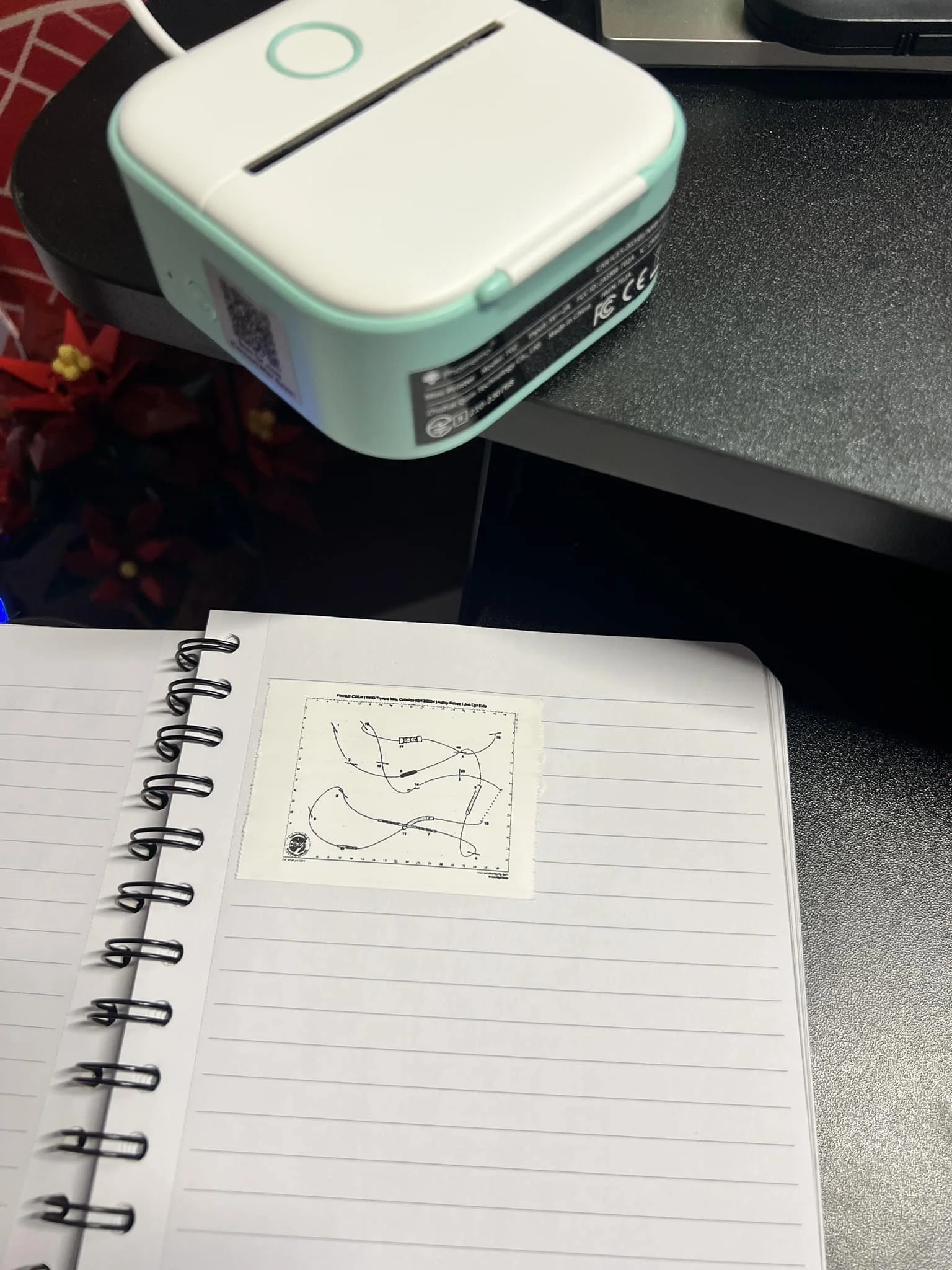
Electronic solutions – such as tablets or mini printers – are great for adding more visualizations to your notes. For instance, Stefanie Theis of Motivated by Dogs and K9 Nut uses a mini printer to print out course maps for her notebook. Considering how expensive and cumbersome regular printers can be, mini printers are portable, affordable, and effective solutions for note-taking in training or trials.
Photo Credit: Stefanie Theis
Whether you prefer electronic or handwritten notes, structure and clarity are essential for any note-taking strategy. To visually differentiate information in my agility notes, I may use three different colors, such as….
Black = General notes about obstacles, numbers, nonverbal handling cues
Green = Verbal cues
Red = Things to watch out for
If you don’t feel like lugging around a bunch of pens on top of treats, toys, poop bags, and all that, here are some alternative ways to visually differentiate information in your notes…
WRITE YOUR MOST IMPORTANT SELF-REMINDERS IN ALL CAPS
Circle all of your verbal cues
Underline notes about crosses or timing of nonverbal handling moves
My Note-Taking Examples
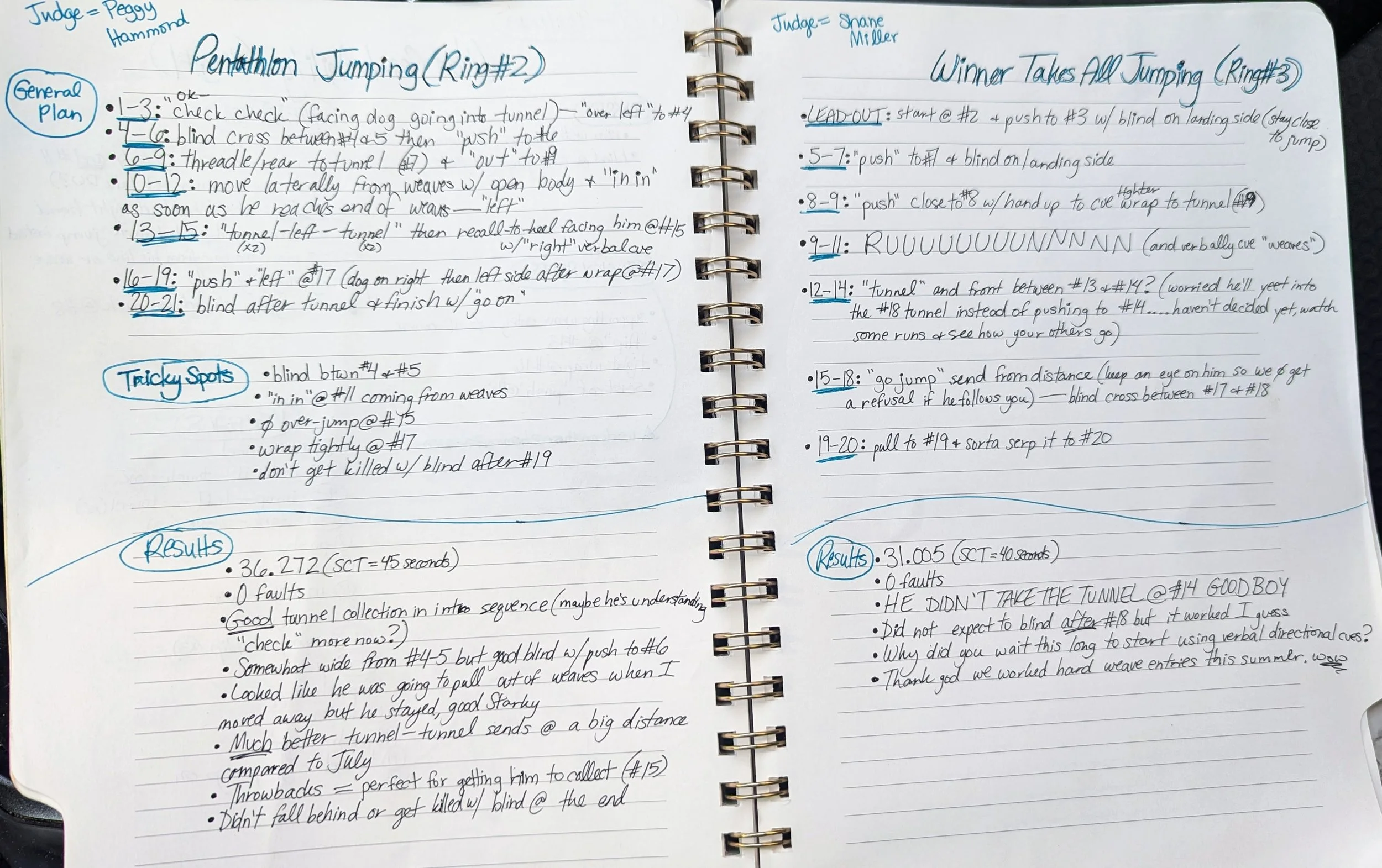
These two examples are from my runs with Stark at the 2023 UKI West Coast Open. As you can see, I don’t always follow the same note-taking structure, but there are some details I always try to include in my notes…
Judge’s name: This information helps me prepare for future events by anticipating potential challenges that particular judge might have on their courses.
Event name + class/level (ring number too, if it’s at a large, 3+ ring event)
Handling plans for 2-4 obstacles (“micro sequences”) per bullet point: For me personally, I find this more useful than one bullet point per obstacle because it helps me connect all the dots of the course by knowing what comes before and after a particular micro sequence. I like to include verbal cues in quotation marks and specific handling information like take-off versus landing side cross positioning for jumps.
Results and reflections: These typically include my dog’s time, any faults we had on-course, unexpected moments, any interesting observations I had about my dog’s performance based on their skills and recent training
Winner Takes All Jumping (WCO, 2023): I was especially grateful for my notes while preparing for this run because it was the very last one of the day for our group (for those unfamiliar with UKI, competitors walk all 4 courses early in the morning then run in scheduled “rotations” that determine which group runs in which ring throughout the day). Needless to say, the late afternoon runs can be quite challenging when you haven’t walked the course in over 6-8+ hours! Stark and I ended up winning this one — check out the video below to see how my handling compared to my early morning notes (right-hand side of the notebook above).
FREE: ECA’s Course Notes Template
Want a more directed, organized note-taking sheet to use at competitions? If “yes” then download our “Course Notes” template, which is free for anyone to use for their own personal purposes*
*If you’d like to customize this template by removing the ECA watermark and rebranding it with your own logos and colors for distribution to your students, we offer a commercial use license for only $15.
This license grants you:
The right to customize the design with your branding (we’re also happy to do this for you for no added cost)
Unlimited printed copies and digital downloads for licensed users
Please complete the form below to order your Custom Course Notes Template.
